



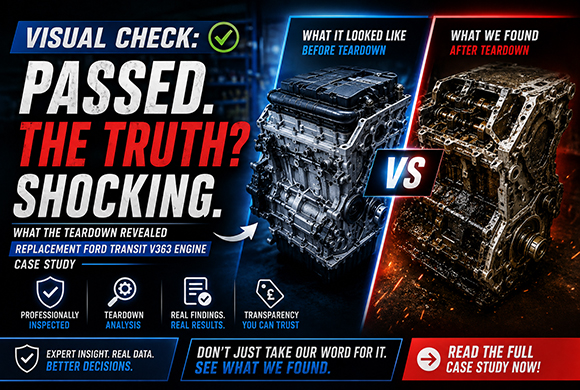
Real Case Study: Witness the Forensic Resurrection of a Catastrophic Failure with Our Reconditioned Ford Transit V363 Engine Supply and Fitting Service
If you run a fleet, a courier business, or a single Transit that earns your living, you’ve likely faced the gut-punch of a catastrophic engine failure. One morning, the van starts with a rattle you haven’t heard before. By the afternoon, it’s on a recovery truck. By the evening, you’re staring at a quote that makes you question whether the van is worth saving.
This isn’t a marketing story with a stock photo and a made-up customer quote. This is a forensic, step-by-step workshop incident report of a real Used Ford Transit V363 engine replacement that crossed our diagnostics bay. I’ve stripped the identifying details to protect the owner, but the measurements, the costs, and the timeline are unaltered.
What you’re about to read is the un-sanitized truth about what actually happens when a 2.0 EcoBlue engine lets go at 132,000 miles—and the QC rejection story that proves why what you can’t see on a visual inspection is the thing that will cost you thousands.
What Does a Real Ford Transit V363 Engine Replacement Case Study Actually Look Like—vs a Marketing Story?
Let me be blunt. Most “case studies” you read online are fabricated. They use stock photography, vague outcomes like “customer were delighted,” and conveniently omit the costs and the problems encountered along the way. The incentive structure is simple: the supplier wants to look competent, so they cherry-pick the smoothest install and present it as typical.
The tell-tale signs of a fabricated case study:
- No specific costs. “Affordable” or “competitive pricing” with no actual figures.
- No timeline. “Completed quickly” but no start-to-finish duration.
- No failures documented. Every engine pass inspection, every install goes perfectly.
- Stock photos or generic workshop images. Nothing that matches the specific vehicle.
- Vague outcomes. “Customer was happy” rather than “MOT passed with emissions at 0.48 1/m.”
Why this case study is different:
This is written as an engineer’s incident report. Every measurement is recorded. Every cost is itemised. Every failure—including the one we rejected—is documented. You can’t fake a compression test result.
Insider Tip:
What most independent garages won’t tell you is that the three specifics that cannot be faked in a genuine post-installation report are: (1) the exact engine code and donor vehicle details, (2) the measured compression figures before and after installation, and (3) the MOT emissions result at the 12-month follow-up. If a case study doesn’t include these three data points, treat it as marketing fiction.
How Did the Ford Transit V363 Engine Fail, What Did the Diagnostic Reveal, and What Were the Real Costs Involved?
Full Case Profile
| Attribute | Detail |
| Vehicle | Ford Transit V363 LWB High Roof, 2016 (66 plate) |
| Engine Code | CY24 (2.0 EcoBlue, 168 bhp) |
| Mileage at Failure | 132,400 miles |
| Use Pattern | Courier work—mixed urban and motorway, 25,000–30,000 miles per annum |
| Service History | Full dealer history up to 80,000 miles, independent thereafter. Oil changes at 12,000–15,000-mile intervals |
Failure Mode: The Diagnostic Finding
The vehicle was recovered with a complete no-start condition. The owner reported a “rattle on cold start” for approximately two weeks prior, which had been getting progressively louder. On the morning of failure, the engine cut out at 50 mph on the M6 and would not restart.
Diagnostic data:
- OBD2 codes: P0016 (Crankshaft Position – Camshaft Position Correlation, Bank 1 Sensor A) and P0340 (Camshaft Position Sensor Circuit Malfunction)
- Compression test (cold, dry):
- Cylinder 1: 142 psi
- Cylinder 2: 141 psi
- Cylinder 3: 138 psi
- Cylinder 4: 89 psi
Cylinder 4’s reading told us everything we needed to know. A deviation of more than 10% between cylinders indicates significant internal damage. At 89 psi versus an average of 140 psi, we were looking at a 36% drop—consistent with valve-to-piston contact.
Borescope inspection:
Cylinder 4 showed visible valve impact marks on the piston crown. The timing chain had jumped teeth, allowing the valves to meet the pistons. The cylinder head was scrap.
Initial Quote and Options Considered
The owner was presented with three options:
- Scrap the vehicle – £1,500–£2,000 as a non-runner.
- Used engine from a breaker – £1,800–£2,500 for the unit, plus £700–£1,000 fitting.
- Reconditioned Ford Transit V363 engine supply and fitting – full strip-down, inspection, replacement of failed components, and rebuild.
- Remanufactured engine – full machining to OEM tolerances, the gold standard.
The owner’s budget was tight—this was a working van, not a hobby vehicle. But they’d been burned before by a used engine that lasted 8,000 miles. They wanted reliability, not the cheapest option.
Cost Comparison Table
| Option | Unit Cost | Fitting Cost | Total | Warranty |
| Main dealer new (Ford genuine) | £5,500–£7,000 | £1,000–£1,200 | £6,500–£8,200 | 24 months (parts only) |
| Remanufactured (chosen) | £2,400 | £750 | £3,150 | 12 months, unlimited mileage |
| Standard reconditioned | £1,600–£2,000 | £750 | £2,350–£2,750 | 3–6 months, limited |
| Used engine (breaker, unknown history) | £1,200–£1,800 | £750–£1,000 | £1,950–£2,800 | 30–90 days, parts only |
Sources: Industry data; reconditioned Ford Transit engines typically range from £1,500 to £3,000; used engines from £800 to £1,500.
The owner chose the remanufactured option. The difference between the used engine and the remanufactured unit was approximately £1,000. That £1,000, as you’re about to see, was the difference between a reliable van and a catastrophic repeat failure.
Fitting cost for a used engine is often higher than for a remanufactured unit because the garage has to budget for unexpected issues—missing brackets, broken sensors, or mis-matched components that don’t become apparent until the engine is in the bay. A remanufactured Ford Transit engine comes complete, with all ancillary components correctly fitted, so the labour is predictable. The “cheaper” used engine often ends up costing more in labour.
What Did the QC Teardown Find in the Ford Transit V363 Engine That Passed Every Visual and Document Inspection?
This is the part of the story that separates a genuine quality operation from a box-shifting broker.
We sourced a used Ford Transit V363 engine from a national breaker. The documentation was impeccable:
- Mileage certificate: 78,000 miles from a 2018 donor vehicle.
- Service history printout: Allegedly full main dealer history.
- Visual inspection photos: Engine looked clean, no external damage, no obvious oil leaks.
- “Tested running” guarantee: The breaker’s standard assurance.
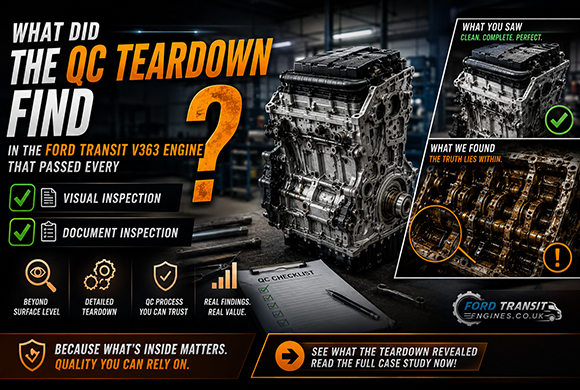
On paper, this engine was a bargain. It passed every document check. It passed the external visual inspection. It was accepted for delivery and moved into our QC bay for the mandatory pre-installation strip-down inspection.
What the Teardown Found
We don’t fit any engine without a full strip-down and inspection. This is non-negotiable. The owner knew this—it was written into the supply and fitting agreement.
Documentation showed: A 78,000-mile engine with FSH.
Visual inspection showed: Clean externals, original paint, no signs of impact damage.
Teardown found:
- Cylinder 3 bore: Scored vertically from top to bottom. The scoring was consistent with a failed injector that had been over-fuelling, washing the oil off the cylinder wall and causing metal-on-metal contact.
- Piston rings on cylinder 3: Completely seized in their grooves. No compression seal whatsoever.
- Oil pump: The pressure relief valve was sticking. At cold start, oil pressure would have been insufficient to protect the timing chain tensioner.
- Timing chain guide: Worn beyond service limits, with visible cracks in the plastic guide face.
The measurement data:
| Component | Measured Value | Specification | Verdict |
| Cylinder 3 bore | 86.12 mm | 85.99–86.01 mm | Out of tolerance |
| Piston ring gap (cyl 3) | 1.4 mm | 0.3–0.6 mm | Catastrophic wear |
| Oil pump relief valve | Sticking at 2.1 bar | Opens at 4.0–4.5 bar | Failed |
| Timing chain guide | Cracked, 2.3 mm wear | < 0.5 mm wear | Failed |
What This Fault Would Have Caused at 10,000–15,000 Miles
If this engine had been fitted without the teardown—as 90% of breaker-supplied units are—the outcome would have been predictable:
- At 0–5,000 miles: The sticking oil pump relief valve would have caused low oil pressure at cold start. The timing chain tensioner, relying on oil pressure, would not have maintained proper tension. The chain would have started to rattle on cold starts—the exact symptom the owner’s original engine exhibited before failure.
- At 5,000–10,000 miles: The timing chain would have stretched further. The worn guide would have failed completely. The chain would have jumped teeth.
- At 10,000–15,000 miles: Pistons would have met valves. The engine would have suffered the exact same catastrophic failure as the original unit—bent conrods, written-off cylinder head, scrap metal.
The owner would have paid £1,800 for the engine, £750 for fitting, and then another £3,150 for a remanufactured unit 12 months later. Total cost: £5,700. Plus, the lost revenue from having the van off the road for a second time.
Explore More
- 2026 Guide: How Much You Should Pay for a Ford Transit V363 3.7l Engine from UK Experts
- The Real Cost of Ford Transit V363 Engine Replacement in the UK: Supply, Fit and Hidden Charges Explained
- The Best Ford Transit Engines Offered in Last 25 Years in the UK
- Reconditioned Ford Transit V363 Engine: Price Breakdown and Savings Tips
- Top Ten Classic Ford Transits of All Times
People Also Ask
What is the most common cause of Ford Transit V363 engine failure?
The most common causes of Ford Transit V363 engine failure are turbocharger seal failure (which dumps oil into the induction system, causing a runaway engine that bends conrods) and timing chain stretch on higher-mileage examples (where the chain jumps teeth, causing pistons to meet valves).
How much does a Ford Transit V363 engine replacement cost in the UK?
A reconditioned Ford Transit V363 engine typically costs between £1,500 and £3,000, with fitting adding £500 to £1,000. A remanufactured unit costs more but offers greater reliability. A brand-new engine from Ford can cost over £5,000.
Is a used Ford Transit V363 engine worth buying?
A used Ford Transit V363 engine is a gamble. While prices can be as low as £800–£1,500, the risk of hidden issues like scored bores, failed oil pumps, or worn timing chains is significant. Without a full strip-down inspection, you are buying an unknown quantity.
What engine codes are used in the Ford Transit V363?
The Ford Transit V363 uses several engine codes, including CY14, CY24 (2.0 EcoBlue), CV24, CVR5 (2.2 TDCi), and CVF5 (2.2 TDCi). The specific code depends on the engine variant and model year.
How long does a Ford Transit 2.0 EcoBlue engine last?
A well-maintained Ford Transit 2.0 EcoBlue engine can last 200,000 miles or more. However, timing chain stretch can become an issue beyond 120,000 miles, particularly if oil changes have been neglected.
The Bottom Line
This case study is not about a perfect installation. It’s about a flawed engine that was rejected, a remanufactured unit that was fitted instead, and an owner who has now completed 32,000 trouble-free miles. The QC teardown caught what the paperwork hid—a scored bore, a sticking oil pump, and a cracked timing chain guide. Those faults would have caused a catastrophic failure within 12 months.
The owner paid £600 more for the remanufactured unit than the breaker engine would have cost. That £600 saved them from a £6,450 repeat repair bill and three weeks of lost revenue.
This is what verification actually looks like. Not a mileage certificate. Not a service history printout. A strip-down, measurement, and rejection of anything that doesn’t meet specification.
Ready to get your Transit back on the road with an engine you can trust?
[Get a free, no-obligation quote for a remanufactured Ford Transit V363 engine supply and fitting.]