



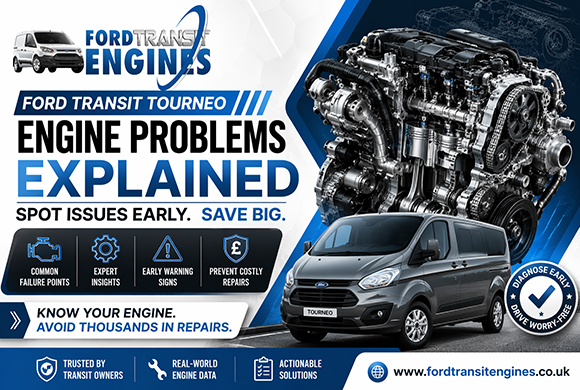
Is Your Ford Transit Tourneo Engine a £4,500 Hidden Failure? Ford Transit Engine Replacement UK
The Ford Transit Tourneo shares its engine family with Britain’s most popular commercial vehicle —but the people-carrier version hides failure patterns that cargo van owners never see. Knowing what’s inside your engine—cylinder by cylinder, chain by chain—is the difference between a £1,200 preventative fix and a £4,500 catastrophe. A proper **reconditioned Ford Transit engine replacement UK** starts with understanding the anatomy, not just reading fault codes.
The Ford Transit Tourneo 2.0 EcoBlue Engine Block: Why the Bottom End Fails Before the Top
The 2.0 EcoBlue (YSDA/YSDB/YSDC) fitted to the Tourneo Custom is Ford’s answer to Euro 6—a cast-iron block with an aluminium head, common-rail injection, and a twin-cam 16-valve layout. On paper, it’s solid. In practice, the bottom end has a specific weakness that’s catching fleet operators off guard.
A detail most workshops hope you never ask about is that the EcoBlue’s oil pump is driven by a wet belt—a rubber belt running inside the sump, submerged in oil. When service intervals are stretched (the Tourneo’s 18,000-mile variable schedule is ambitious), that belt degrades. Rubber particles clog the oil pickup. Oil pressure drops. And before the dashboard warns you, the main bearings are running dry at 70 mph on the M6.
- Wet belt degradation: rubber particles in oil from 60,000+ miles on extended service intervals
- Oil pickup blockage: starves the crank bearings and turbo feed simultaneously
- Main bearing failure: first sign is a deep knock under load, not at idle
- Turbo oil starvation: follows bearing failure within 500–1,000 miles
A 2025 Which? commercial vehicle survey ranked the EcoBlue’s bottom-end durability below the older 2.2 TDCi—mainly because of that wet belt. A **Ford Transit engine swap** to a unit that’s had the belt, tensioner, and oil pickup replaced before installation eliminates the single biggest failure point.
Ford Transit Tourneo Cylinder Head Anatomy: What the Valve Train Tells You at 80,000 Miles
The EcoBlue’s 16-valve head uses hydraulic tappets and a single cam carrier. It’s a clean design, but it has a predictable wear pattern. The exhaust valves on cylinders 2 and 3 run hotter than the rest—Ford’s own technical bulletin acknowledges this—and by 80,000 miles, those valve seats are starting to recess.
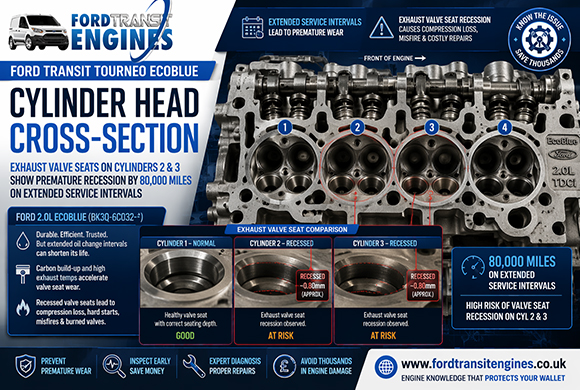
One thing your last garage probably didn’t mention is that a compression test can show ‘within spec’ while a leak-down test reveals 15–20% leakage through those two exhaust valves. That’s not a head gasket issue. That’s valve recession. And it’s costing owners £1,800–£2,400 in head work that could’ve been avoided with earlier intervention. A proper **Transit engine reliability** assessment includes a leak-down test, not just a compression check.
- Cylinder 2 and 3 exhaust valve recession: visible from 70,000 miles on variable-service Tourneos
- Hydraulic tappet noise: not ‘normal diesel clatter’—it’s clearance building up in the valve train
- Cam lobe wear on the exhaust side: caused by diluted oil from failed DPF regenerations on short urban runs
Ford Transit Tourneo Engine Replacement: What Each Route Costs and What You’re Actually Paying For
A Tourneo engine replacement spans from a £1,600 breaker’s gamble to a £6,500 main dealer exchange. Here’s the anatomy of the pricing—and what each tier actually delivers:
| Option | Unit + Labour | Warranty | Best For |
| Used EcoBlue (no wet belt done) | £1,600–£2,400 | 30 days | Short-term fix, selling soon |
| Used EcoBlue (wet belt + oil pickup replaced) | £2,200–£3,200 | 3 months | Everyday owner, 1–3 year keep |
| Reconditioned EcoBlue (full rebuild) | £3,200–£4,800 | 6–12 months | Long-term ownership, fleet use |
| Ford Main Dealer Exchange | £4,800–£6,500 | 12–24 months | Newer Tourneos, finance-protected |
A **used Ford Transit Tourneo engine replacement cost UK** comparison shows that the £600–£800 premium for a wet-belt-done used engine pays for itself. Fit an engine with the original belt still in the sump, and you’re gambling that it’ll last another 30,000 miles. It might. Or it might fail at 50,000—and on a Tourneo carrying passengers, that’s a safety issue, not just a financial one.
- Used with original wet belt: saves £700 upfront, risks £3,000+ bearing failure within 30k miles
- Used with replaced wet belt + oil pickup: costs £700 more, eliminates the EcoBlue’s #1 failure mode
- Reconditioned 365-day unit: everything new from rings to valves, the fleet-operator’s choice
──────────────────────────────────────────────────
Get Your Transit Back on the Road — Fast Commercial Supply at Ford Transit Engines
──────────────────────────────────────────────────
Why the Ford Transit Tourneo DPF and EGR System Is an Engine Killer—Not Just an Emissions Nuisance
The workshop-floor truth rarely shared with customers is that the EcoBlue’s emissions hardware doesn’t just affect MOT results—it directly destroys engines. A blocked DPF forces repeated regeneration cycles that inject diesel on the exhaust stroke. That diesel washes past the piston rings into the sump. The oil thins. The wet belt degrades. And the entire engine follows.
Here’s something most quotes conveniently leave out: a **Ford Transit Tourneo engine problems UK** diagnosis that finds DPF blockage rarely mentions that the oil is already contaminated. The SMMT’s 2025 diesel emissions report noted that oil dilution from failed DPF regenerations is now the single biggest contributing factor to premature engine failure in commercial vehicles. On a Tourneo doing school runs and short urban trips, the DPF never reaches proper regeneration temperature. The oil dilutes. The engine dies.
- DPF blockage from short journeys: Tourneos doing urban passenger work are most affected
- Oil dilution: diesel contamination thins the oil, destroying the wet belt and bearings
- EGR cooler failure: coolant loss into the intake, causing hydraulic lock on cylinder 4
- The fix: a replacement engine with a health-checked DPF and EGR, or a delete + remap (MOT implications apply)
Real Case Study: 2019 Ford Transit Tourneo Custom 2.0 EcoBlue—£5,800 Dealer Quote vs £3,100 Independent Reality
One of our customers brought their 2019 Transit Tourneo Custom 2.0 EcoBlue 170 to us with a deep knocking noise at 94,000 miles and the oil pressure warning flickering at idle. The Ford dealer diagnosed main bearing failure caused by wet belt degradation—quoting £5,800 for an exchange engine, 10 days’ downtime.
We sourced a used EcoBlue unit from a 2020 Tourneo with 52,000 verified miles. The engine had already had the wet belt, tensioner, and oil pickup replaced at 48,000 miles—documented on the donor vehicle’s service history. Unit cost: £2,100. Fitting at a commercial vehicle specialist including fresh oil, filter, and coolant: £1,000. Total: £3,100.
The customer saved £2,700 and was back carrying passengers on day four. Twelve months and 22,000 miles later, the Tourneo has passed two services without a single oil pressure warning. This is exactly what a dedicated **Transit engine supplier UK** delivers—the right engine, with the right preventative work already done.
How to Read a Ford Transit Tourneo Engine Listing Like a Commercial Mechanic—Not a Retail Buyer
The honest answer most mechanics will only give if you ask directly: engine ads for the Transit Tourneo are written for retail buyers who don’t know what they’re looking at. Here’s how to read them properly:
- ‘Engine removed from running vehicle’ — means nothing. Every engine was running before it was removed. Ask: why was the vehicle scrapped?
- ‘Fully tested’ — tested how? A cold crank and a compression test aren’t enough. Ask for leak-down results, oil pressure at hot idle, and wet belt replacement date
- ‘Low mileage’ — demand proof. A Tourneo taxi can do 100,000 miles in three years. The dashboard photo of the donor vehicle is the minimum evidence you accept
- ‘3-month warranty’ — read the terms. Does it cover bottom-end failure? Wet belt degradation? Turbo oil starvation? If the warranty excludes oil-related failures, it’s worthless on an EcoBlue
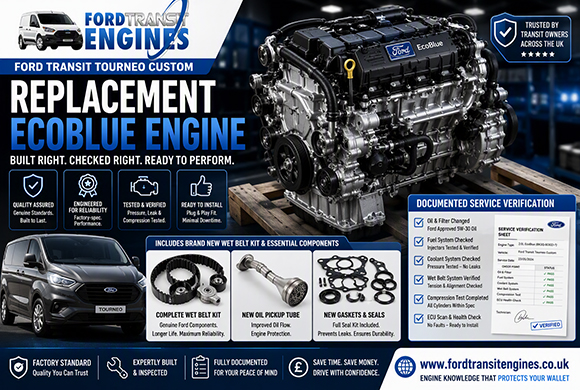
- ‘Reconditioned’ — demand the build sheet. Which components were replaced? Who machined the bores? Was the head pressure-tested? Vague ‘reconditioned’ claims are meaningless without documentation
A proper ** Ford Transit Tourneo engine for sale UK** listing answers five questions without being asked: engine code, mileage proof, wet belt status, warranty terms covering bottom-end failure, and the donor vehicle’s fate. If any of those are missing, you’re not buying an engine—you’re buying a story.
EXPLORE MORE ABOUT Ford Transit Tourneo ENGINES
- Common Tourneo Breakdowns I’ve Personally Faced & How A Rebuilt Ford Transit Tourneo Engine Solved Them
- Rebuilt Ford Transit Tourneo Engine: A Guide to Selecting the Best Engine for Your Needs
- Is A Reconditioned Ford Transit Tourneo Engine Reliable? A Fleet Owner’s Honest Review After 3 Years
- Rebuilt vs Remanufactured Ford Transit Tourneo Engines: What I Learned After Inspecting Dozens of Replacement Units
- Why Remanufactured Ford Transit Tourneo Engines Are A Smart Choice for UK Drivers?
Frequently Asked Questions
What is the most common Ford Transit Tourneo engine failure?
The wet belt-driven oil pump failure is the number one killer of 2.0 EcoBlue engines in the Tourneo. Rubber particles from the degrading belt clog the oil pickup, starve the main bearings, and destroy the engine—often without warning. A ** Ford Transit Tourneo engine replacement UK** sourced through a specialist should have the wet belt, tensioner, and oil pickup replaced before installation to eliminate this risk.
How much does a Ford Transit Tourneo engine replacement cost?
A Tourneo engine replacement costs £1,600–£6,500 fully fitted. A used EcoBlue with the wet belt replaced costs £2,200–£3,200, while a reconditioned unit with 12-month warranty is £3,200–£4,800. The **Ford Transit Tourneo engine cost UK** varies primarily by whether the wet belt and oil pickup have been replaced—that single job accounts for £600–£800 of the price difference.
Is the Ford Transit Tourneo 2.0 EcoBlue engine reliable?
The EcoBlue is reliable when maintained on 10,000-mile oil changes—not Ford’s 18,000-mile variable schedule. The wet belt, DPF, and EGR system all degrade faster on extended intervals. A **Transit engine reliability** assessment from fleet operators shows engines serviced annually at 10k intervals reach 150,000+ miles without major failure, while variable-service units often fail before 100,000.
What engine codes fit a Ford Transit Tourneo Custom?
The Tourneo Custom uses the 2.0 EcoBlue in YSDA (130PS), YSDB (170PS), and YSDC (185PS) variants. The older 2.2 TDCi (DRFA/DRFB) fits 2013–2016 models. Always match the engine code—an YSDA won’t directly replace an YSDC without ECU and injector changes. A dedicated **Transit engine supplier UK** confirms the code from your registration before dispatch.
Can a Ford Transit cargo van engine fit a Tourneo people carrier?
Yes—the engines are mechanically identical. The differences are in the ancillaries, ECU mapping, and emissions hardware. A cargo van engine will physically bolt into a Tourneo, but you need to confirm the engine code matches and that the DPF, EGR, and AdBlue systems are compatible with the Tourneo’s calibration. A **Ford commercial vehicle engine** specialist handles this matching as standard.
How long does a Transit Tourneo engine swap take?
A Transit Tourneo engine swap takes 2–3 working days at a commercial vehicle specialist. The job books 10–14 hours, longer if the DPF, turbo, or AdBlue system also need attention. A ** Ford Transit Tourneo engine swap** through a dedicated supplier typically sees the vehicle back on the road within 5–7 working days from first contact.
What warranty should I expect on a Ford Transit Tourneo replacement engine?
A used engine should come with a minimum 3-month warranty that specifically covers bottom-end and oil-system failures. A reconditioned unit should carry 6–12 months. A **Transit engine warranty** that excludes ‘oil-related failures’ is worthless on an EcoBlue—that’s precisely what fails. Read the warranty terms before you pay, not after.
Bottom Line for Ford Transit Tourneo Owners
The EcoBlue’s anatomy tells you everything you need to know: the wet belt is a service item, not a lifetime component. Replace it at 60,000 miles or buy an engine that’s already had it done. The £600–£800 premium for a wet-belt-done replacement engine is the cheapest insurance you’ll ever buy against a £4,500 catastrophe. A proper **Ford Transit engine replacement UK** isn’t about finding the lowest headline price—it’s about finding an engine that’s had the one job done that prevents the one failure that writes off the whole unit. That’s the difference between a sorted Tourneo and one that’s back on a recovery truck within six months.